

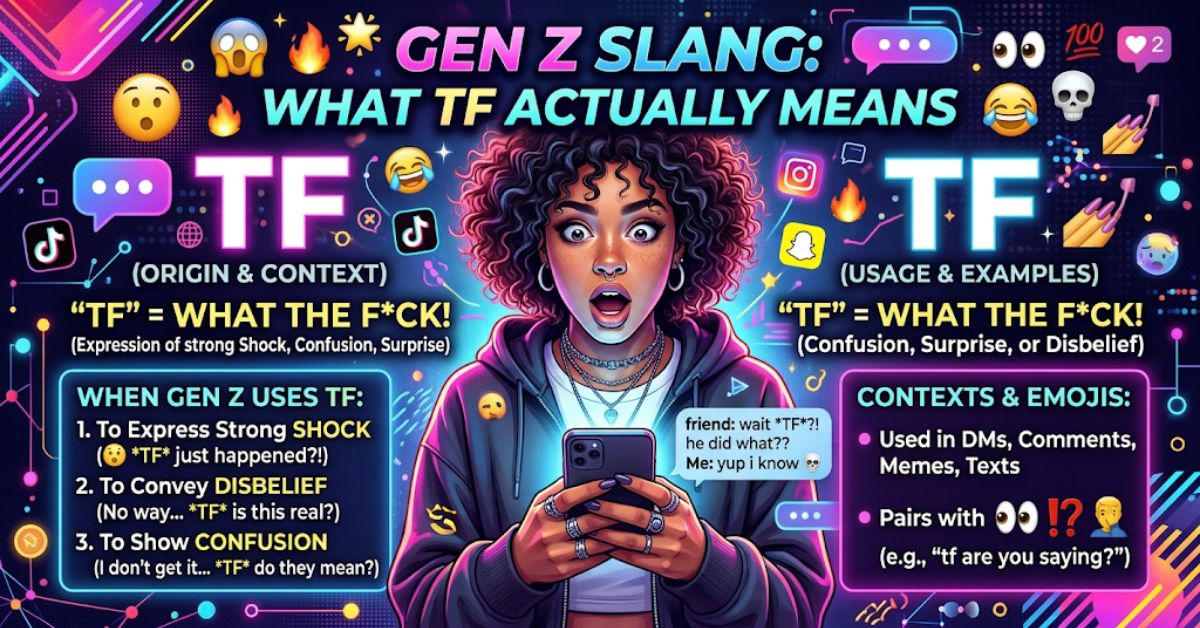
Ever received a message saying TF? and wondered what the person meant? You’re not alone! TF is a popular slang abbreviation that appears in texting, social media comments, and everyday online chats. It stands for The F*** and expresses strong emotions like surprise, confusion, frustration, or disbelief. Gen Z often uses it when something unexpected happens or leaves them speechless. You’ll commonly spot it on WhatsApp, Instagram, TikTok, Snapchat, and Discord.
Understanding tf meaning in gen z makes it easier to follow modern conversations and internet trends. But there’s more to this slang than its basic definition. Depending on the situation, TF can sound funny, playful, confused, or even rude. It also contains profanity, so knowing when to use it matters. Let’s look at its meaning, common uses, and real-life texting examples.
What Does TF Mean In Chat?
TF usually means The F* in texting and online conversations. People use it to express surprise, confusion, frustration, or disbelief. It adds strong emotion to a short message.
For example, someone might text TF? when they cannot understand something. Others use it to react to unexpected news or a strange situation.
In Gen Z conversations, TF often makes messages sound more dramatic, funny, or direct. However, its meaning depends on the situation and the person’s tone.
You may see it in:
- WhatsApp and Instagram DMs.
- TikTok comments and captions.
- Snapchat messages and group chats.
- Discord conversations and gaming chats.
- X (Twitter) posts and online memes.
Example conversation:
- Alex: He canceled the trip again.
- Sam: TF? That’s the third time!
Featured Snippet Answer
TF stands for The F*** in texting. It’s a casual slang abbreviation Gen Z uses to express surprise, confusion, frustration, or disbelief in online conversations.
Simple Meaning (Explained Easily)
The simplest meaning of TF is The F***. It’s an informal expression that adds emotion to a question, reaction, or statement.
Think of it as a stronger version of what, why, or how. People often use it when something catches them off guard or makes little sense.
For example, if your friend suddenly changes plans, you might reply, TF? This shows that you’re confused or surprised.
Here are some common ways people use it:
- Confusion: TF is happening here?
- Surprise: TF! I didn’t expect that.
- Frustration: TF is taking so long?
- Disbelief: TF did I just see?
- Humor: TF is this outfit? 😂
The expression can sound playful between close friends. However, it may seem rude in serious conversations or unfamiliar social settings.
Where Is It Used?
TF appears across social media, messaging apps, gaming platforms, and everyday digital conversations. Gen Z users often prefer short expressions because they make reactions quick and easy.
You don’t need a special platform to use it. Any space that supports casual messaging can include this abbreviation.
Here are some common places where you’ll encounter TF:
- WhatsApp: Friends use it in private chats and group conversations.
- Instagram: It appears in comments, reels, stories, and DMs.
- TikTok: Users add TF to funny reactions and viral comments.
- Snapchat: People use it when responding to surprising snaps.
- Discord: Gamers use it during unexpected moments.
- X (Twitter): It appears in memes, replies, and trending discussions.
- Reddit: Users include it when reacting to unusual posts.
Example conversation:
- Mia: Did you see his latest TikTok?
- Jake: Yeah, TF was that? 😂
Why Do People Use It?
People use TF because it communicates strong feelings without requiring a long explanation. A simple abbreviation can show surprise, annoyance, confusion, or excitement.
Gen Z also uses internet slang to make conversations feel relaxed and natural. TF fits perfectly into quick replies, memes, and playful exchanges.
Here are the main reasons people use it:
- Save time: Three letters can replace a longer reaction.
- Show surprise: It expresses shock when something unexpected happens.
- Express frustration: It helps communicate annoyance quickly.
- Add humor: Friends use it to make funny reactions more entertaining.
- Emphasize emotions: It makes questions and statements sound stronger.
- Follow internet trends: Slang helps people participate in online conversations.
Example conversation:
- Ryan: I accidentally sent that message to my teacher.
- Emma: TF 😭 How did that happen?
In this example, TF highlights Emma’s shock. The crying emoji makes the reaction feel humorous rather than angry.
Examples (Real-Life Situations)
The best way to understand TF is through everyday texting situations. Its meaning can change depending on the conversation and emotional tone.
Friends often use it when something unexpected, confusing, or hilarious happens.
Here are some realistic examples:
1. When you’re surprised
- Alex: She bought a new car yesterday.
- Ben: TF! That’s amazing!
2. When you’re confused
- Mia: The meeting starts at 5 AM.
- Sara: TF? Who schedules meetings that early?
3. When you’re annoyed
- Jake: The internet stopped working again.
- Tom: TF is wrong with this Wi-Fi?
4. When something is unbelievable
- Emma: He finished the entire project overnight.
- Lily: TF! How is that even possible?
5. When something is funny
- Ryan: My cat knocked over the birthday cake.
- Sam: TF 😂 Your cat has no chill.
6. When reacting to unexpected news
- Noah: They’re moving to another country next week.
- Liam: TF? I didn’t know they were leaving!
These examples show how TF changes with different situations. Context helps you understand whether someone feels confused, amused, or frustrated.
TF vs Similar Terms
TF isn’t the only abbreviation people use in online conversations. Several other slang terms express surprise, confusion, or disbelief.
However, each one carries a slightly different meaning. Understanding these differences helps you choose the right expression.
| Slang | Full Form | Common Use |
| TF | The F*** | Strong surprise or confusion |
| WTF | What The F*** | Shock, disbelief, or frustration |
| WTH | What The Heck | Mild surprise or confusion |
| FR | For Real | Agreement or disbelief |
| OMG | Oh My God | Surprise or excitement |
| SMH | Shaking My Head | Disappointment or disbelief |
| IDK | I Don’t Know | Uncertainty |
| NGL | Not Gonna Lie | Honest opinion |
Example conversation:
- Alex: He forgot his own birthday.
- Sam: WTF! How does that happen?
- Alex: FR, I couldn’t believe it.
Remember that TF and WTF contain profanity. WTH and OMG are generally softer alternatives.
When Should You Use It?
TF works best in casual conversations with people who understand internet slang. You can use it when reacting to surprising messages, funny situations, or unexpected news.
However, it isn’t suitable for every conversation. Its profanity can make your message sound aggressive or disrespectful.
Good situations to use TF:
- Chatting with close friends.
- Reacting to funny memes.
- Commenting on surprising social media posts.
- Talking casually in gaming groups.
- Sharing jokes in private group chats.
- Expressing disbelief about unexpected news.
Situations where you should avoid it:
- Professional emails and workplace messages.
- Conversations with teachers or employers.
- Formal discussions and interviews.
- Serious conversations with unfamiliar people.
- Situations where profanity could offend someone.
Example conversation:
- Jake: I won the competition!
- Mike: TF! That’s incredible, bro!
Here, TF communicates excitement and surprise. The friendly relationship makes the informal language appropriate.
Common Misunderstandings
Although TF usually means The F*** in texting, people sometimes misunderstand its meaning. That’s because abbreviations can have different meanings across online communities.
For example, someone unfamiliar with internet slang might think TF is a typo or a random combination of letters.
Here are some common misunderstandings:
- Thinking it’s always rude: TF contains profanity, but friends sometimes use it playfully.
- Confusing it with WTF: Both express strong reactions, but WTF includes the word What.
- Assuming it means anger: It can express surprise, confusion, humor, or disbelief.
- Thinking everyone understands it: Older users or people unfamiliar with Gen Z slang may not recognize it.
- Ignoring the context: The same abbreviation can sound funny in one conversation and aggressive in another.
- Assuming it’s always negative: People also use TF when reacting positively to unexpected events.
Example conversation:
- Mia: TF! You actually won?
- Emma: Yes! Why do you sound so surprised? 😂
In this example, Mia expresses disbelief rather than anger. The surrounding conversation makes her meaning clear.
Pro Tips (Important Usage Advice)
Knowing what TF means is only the first step. You should also understand how to use it naturally without making your messages sound offensive.
A little attention to tone and context can make online conversations easier.
Keep these tips in mind:
- Understand the audience: Use TF with friends who are comfortable with casual slang.
- Check the context: Make sure the situation suits informal language.
- Don’t overuse it: Repeating TF in every message can make your texting feel unnatural.
- Use emojis carefully: 😂 or 😭 can make playful reactions easier to understand.
- Know softer alternatives: Choose WTH or OMG when you want to avoid profanity.
- Avoid professional settings: Keep workplace and formal messages respectful.
- Read the full conversation: Understand the other person’s tone before replying.
Example conversation:
- Alex: I got tickets to the concert!
- Sam: TF! I’m so excited!
This sounds natural between close friends. But if you’re messaging a manager or teacher, a simple That’s amazing! would be more appropriate.
Ultimately, TF is a short and expressive slang term. Use it thoughtfully, and pay attention to how others communicate.
Final Thoughts
Understanding tf meaning in gen z makes texting and online conversations much easier. TF stands for The F*** and expresses surprise, confusion, frustration, or disbelief. Gen Z often uses it in messages, comments, and social media posts. The tf meaning in gen z can change with the situation and tone. It may sound funny among friends or rude in serious conversations. Knowing its meaning helps you understand what someone really wants to say.
Now that you know tf meaning in gen z, you can recognize it in everyday chats. Use it when talking casually with friends who understand this slang. Avoid using it in professional messages or formal discussions. Remember, context matters just as much as the abbreviation itself. If you want a softer reaction, try OMG or WTH instead. Use TF wisely and keep your conversations clear and friendly.
FAQ
What does TF mean in texting?
TF stands for The F***. It expresses surprise, confusion, frustration, or disbelief in casual online conversations.
Is TF considered a bad word?
Yes, TF contains profanity. The tf meaning in gen z is informal, so avoid using it in professional conversations.
Can TF be used jokingly?
Yes, friends often use TF jokingly to react to funny, strange, or unexpected situations without sounding serious.
What is the difference between TF and WTF?
TF means The F***, while WTF means What The F***. Both express surprise, confusion, or disbelief.
Is TF still popular among Gen Z?
Yes, TF remains common in texting and social media. Understanding tf meaning in gen z helps you follow online slang.
