


Ever heard someone shrug and say “c’est la vie” after a rotten day, and wondered what they really meant? Maybe you’re also worried about using it wrong in a text or an email.C’est la vie means “that’s life” in English. It’s a French expression people use to accept something they can’t change.
Stick around and you’ll get the full C’est la vie meaning, its origin, real usage examples, and the moments where it can backfire. No jargon, just plain talk.
What Does “C’est la Vie” Mean?
The meaning of C’est la vie is simple. Things happen, and that’s just how life goes.
You say it when something goes wrong and you can’t fix it.
It mixes acceptance with a small dose of resignation.
Picture a friend whose train gets cancelled. She sighs, grabs a coffee, and says, “Oh well, c’est la vie.”
Here’s a clean C’est la vie definition: a French saying that accepts life’s unpredictability with a calm shrug.
It isn’t giving up. It’s letting go of things beyond our control.
Understanding Cest La Vie Meaning (Word-By-Word)
Let’s break the phrase apart. The word-by-word meaning shows why it feels so neat in French language and a bit odd in English.
| Word | Meaning | Quick Note |
| C’est | It is / that is | A short form of “ce” plus “est” |
| La | The | A feminine article |
| Vie | Life | A feminine noun |
The literal translation is “it is the life.” That sounds clunky in English, so translators go with “that’s life.”
This is a classic case where French-to-English translation works better when you chase the feeling, not the exact words.
So why “la” and not “le”? Because vie is a feminine noun in French.
The la vie meaning on its own is just “life,” the same word you’d spot in “la vie en rose.”
Origin of “C’est La Vie”
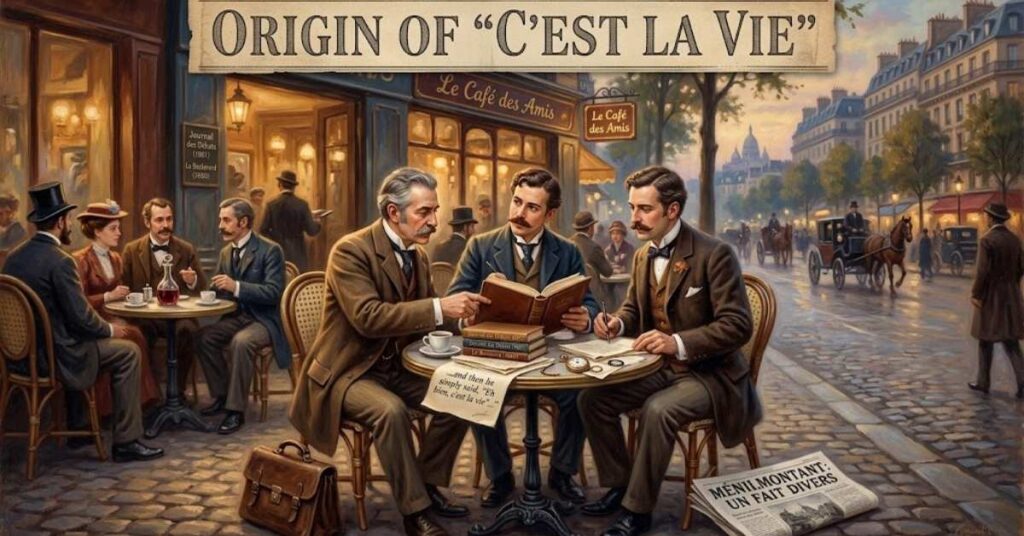
Nobody invented this phrase on a particular day. It grew out of everyday French linguistic history, passed along in kitchens, markets, and letters.
That’s why you won’t find one famous author who “owns” it.
English writers were borrowing it by the nineteenth century. French carried real social weight back then, so travelers and novelists picked up French phrases to sound worldly.
The exact first recorded usage is hard to pin down, so be careful with any site that names a single inventor.
The phrase also lives across the Francophone world, not only in France.
It travels well because the feeling behind it is universal. Everybody’s plans fall apart sometimes.
Over time, English speakers kept it as a ready-made package. It’s short, easy to say, and carries a mood that plain English words don’t quite match.
That staying power explains why you still hear it in 2026, in group chats, captions, and coffee shop small talk.
Cest La Vie In English
In English, the C’est la vie meaning in English is “that’s life,” “such is life,” or “oh well.”
Dictionaries list it as a borrowed phrase, so you don’t need to italicize it or explain it every time.
English speakers use it a little differently, though. We tend to treat it as a light, slightly wry shrug.
It often follows minor disappointments like a burnt dinner or a missed bus.
Compare it with “it is what it is.” That one sounds blunt and flat.
C’est la vie feels softer, with a hint of charm and a touch of emotional acceptance.
Pop culture helped too. Chuck Berry’s 1964 song “You Never Can Tell” leaned on the phrase, and many English speakers met it through music and movies.
That’s how a French idiom became part of everyday language and modern language.
How to Pronounce and Spell C’est la Vie
Say it like “say lah vee.” The “t” at the end of “c’est” stays silent here.
If you’ve searched “say la vie meaning,” you probably heard it out loud and spelled it by sound.
The correct spelling is c’est la vie, with an apostrophe and no accent marks.
Plenty of people type “cest la vie” in texts, and that’s fine in casual chat.
For anything polished, like a blog post or a work email, keep the apostrophe.
It’s a tiny detail, but it shows you know your French vocabulary.
When Should You Use “C’est La Vie”?
Use it when something goes sideways and the fix isn’t in your hands.
It works best for small to medium setbacks, not heavy ones.
Here are appropriate situations for C’est la vie:
- Last-minute cancellation: Your dinner plans fall through an hour before. “Bummer. C’est la vie. Pizza at home it is.”
- Missed opportunities: The concert tickets sold out in two minutes. “Oh well, c’est la vie. Maybe next tour.”
- Minor disappointments: The cafe runs out of your favorite pastry. You smile and pick another.
- Unexpected situations: Rain ruins the picnic, so you move it to the living room floor.
- Self-reflection: You made a small mistake and want to move on without beating yourself up.
The trick is the pause that follows. After you say it, take one small step forward.
That’s what separates graceful acceptance from plain shrugging.
Think of it as a quick reset button. You acknowledge the life’s challenges, you breathe, and you carry on.
It’s a nice little tool for stress management when your day throws a curveball.
C’est La Vie in Professional and Social Settings
At work, keep it light and keep it with people you know.
C’est la vie in professional communication works with a teammate over chat, not with a new client.
Say a client moves a deadline for the third time. You might tell a colleague, “That’s frustrating, but c’est la vie. Let’s adjust the plan.”
It lightens the mood and nudges the team toward adaptability.
In workplace communication with senior leaders or formal emails, skip it.
Try “we’ll adapt” or “we’ll adjust the schedule” instead.
C’est la vie in social conversations is much easier.
With friends, it’s a friendly way to laugh off a bad day and keep the casual conversation going.
When You Shouldn’t Say “C’est La Vie”
Don’t use it when someone is grieving or hurting.
If a friend just lost a job, “c’est la vie” can sound cold, like you’re brushing off their pain.
Skip it when the problem is fixable too.
If your team keeps missing deadlines because of a broken process, shrugging it off hides the real issue.
Also avoid using it to excuse your own repeated errors.
Learning from mistakes matters more than a clever phrase, and it fuels real personal growth.
C’est La Vie as a Philosophy of Life
For many people, this phrase turns into a personal mantra.
It nudges you to accept life’s ups and downs without losing your positive mindset.
There’s a quiet philosophy of life behind it. Some things you can change, and some you can’t.
It echoes the Stoic idea of focusing on what you control and letting the rest go.
This isn’t passive acceptance of fate. It’s emotional resilience in everyday clothes.
You feel the disappointment first, then you choose how to respond.
Think of the rich tapestry of life as a mix of joyous moments and challenging moments.
Saying “c’est la vie” helps you hold both without panic.
A small habit can help here:
- Name the setback in one sentence.
- Ask what’s in your control, even if it’s tiny.
- Say the phrase, then take one next step.
That’s coping with disappointment without drama.
Over weeks, it builds an open mindset that handles unpredictable events better.
Common Mistakes People Make With C’est La Vie
The biggest slip is using it too often. If every problem gets the same shrug, the phrase loses its charm.
Save it for moments that deserve a calm reset.
Another mistake is treating it as a cure for real stress.
If a setback keeps hurting, talk to someone you trust instead of repeating a personal mantra on loop.
People also overthink the grammar. You don’t need to add anything after it.
A simple “Well, c’est la vie” says everything in four words.
Similar Phrases to Use Instead
Sometimes another phrase fits the moment better.
Here are a few alternatives and meaning options.
| Phrase | Language | Feel |
| That’s life | English | Neutral and easy |
| Such is life | English | A little formal |
| It is what it is | English | Blunt and flat |
| Tant pis | French | “Too bad,” quick and dismissive |
| Que sera, sera | Spanish style, popular in English | Calm trust in whatever comes |
| Shikata ga nai | Japanese | “It can’t be helped” |
Each one carries its own cultural philosophy.
Pick the phrase that matches the mood you want.
If you’re into language learning, collecting these is a fun habit.
They teach you more about French culture and other cultures than a grammar chart ever will.
Conclusion
C’est la vie means “that’s life,” a calm way to accept what you can’t change. Its roots run deep in French language and French culture, and English speakers have loved it for generations.Use it for small bumps, pair it with a next step, and save it for people who’ll get the tone. When someone is truly hurting, pick kinder words.
Now it’s your turn. What’s the last thing that made you say “c’est la vie”? Drop it in the comments and share this guide with a friend who loves everyday phrases.If you enjoy word meanings and common expressions, you’ll like our guides on TFTI meaning and Leafs or Leaves too. They’re great for building your vocabulary for students and everyday readers alike.
FAQs
What Does c’est la vie Mean in Slang?
In slang and texting, it’s a casual shrug. It basically means “oh well” or “whatever, it happens.” People often type it as “cest la vie” and attach it to a joke or a bad-luck story.
Does “c’est la vie” Mean Goodbye?
No. It has nothing to do with farewells. Some folks mix it up because it sounds like a closing line after a sigh.For goodbyes in French, try “au revoir,” “salut,” or “à bientôt.” Those are the real French-English expressions for parting.
Is c’est la vie Positive or Negative?
It’s neutral, leaning toward resignation. The feeling depends on your voice and the situation.Said with a smile, it signals a positive mindset and easy acceptance. Said flatly after bad news, it can sound defeated.
Is It “Cest la Vie” or “C’est la Vie”?
The correct form is c’est la vie, with an apostrophe. “Cest la vie” is a common typo, and it’s fine in a quick text.In formal writing, use the apostrophe every time. It keeps your spelling clean and trustworthy.
