

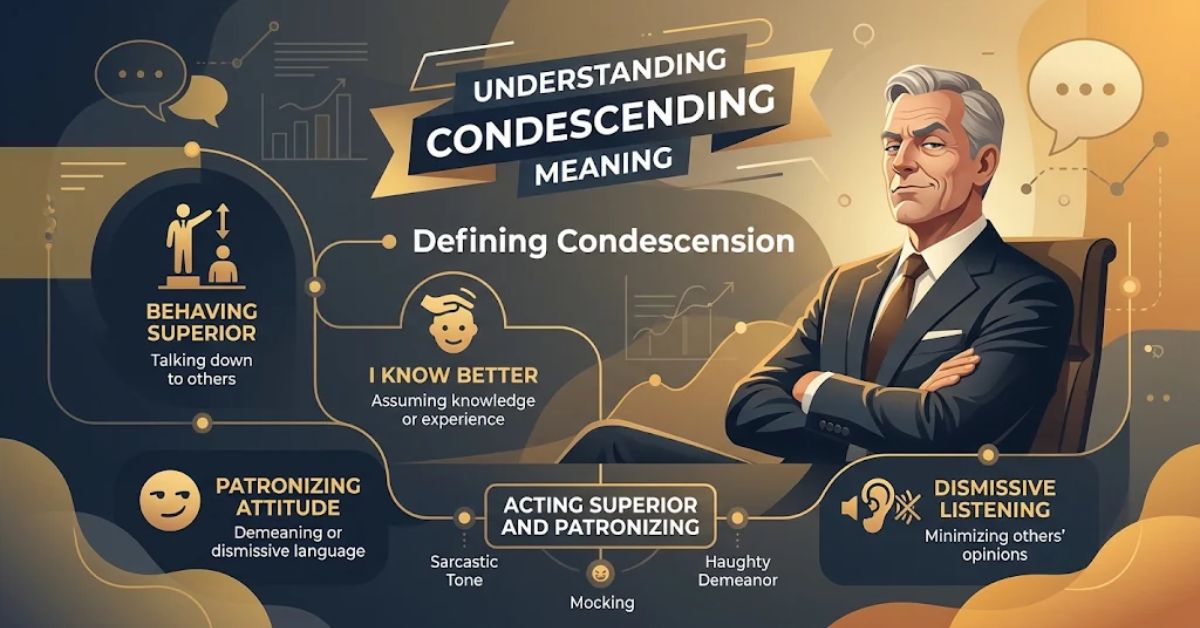
A few words can turn a normal conversation into an uncomfortable experience. Have you ever met someone who explains simple things as if you’re not smart enough to understand? That’s what condescending behavior often feels like. The term condescending mean describes acting superior, talking down to others, or making them feel less important. Even polite words can sound insulting when the speaker uses a dismissive tone.
Recognizing this behavior can help you understand conversations and handle difficult people with confidence. But how is condescending different from being rude, arrogant, or patronizing? What makes someone act this way, and how should you respond? You’ll find clear definitions, everyday examples, useful synonyms, and opposite meanings ahead. You’ll also learn how to spot a condescending tone and communicate without making others feel inferior.
What Does Condescending Mean?
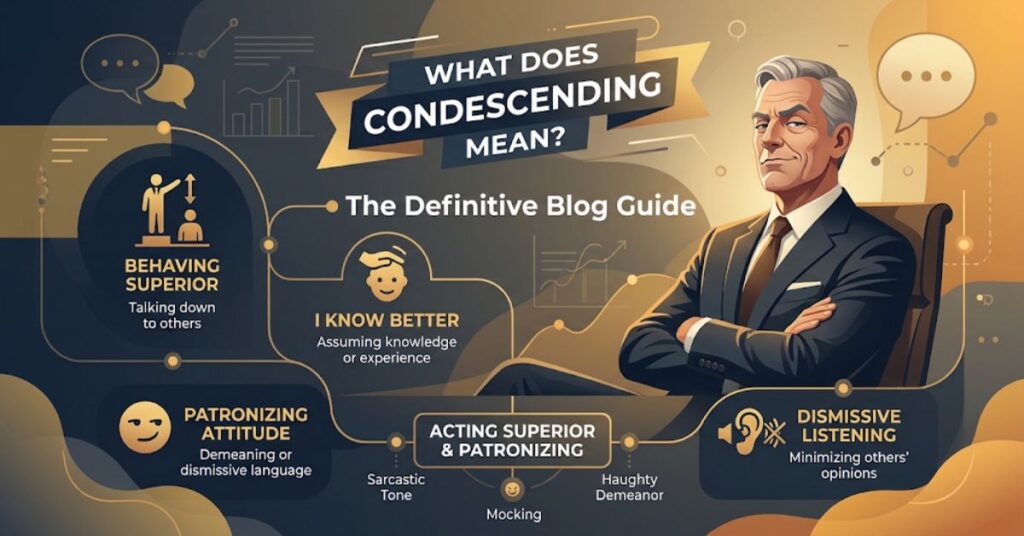
The word condescending describes someone who talks or behaves as if they’re better than other people. It often involves showing superiority or treating others as less intelligent, capable, or important. A person with a condescending attitude may think they know more than everyone else.
The condescending mean in everyday language is simple: talking down to someone instead of treating them as an equal. This behavior can make others feel small, embarrassed, or disrespected.
For example, someone might say, “Let me explain this in a way you can actually understand.” Even if they intend to help, their words sound insulting.
Simple Definition
Condescending means acting superior while speaking to or treating another person. It often appears through word choice, tone of voice, facial expressions, or unnecessary advice.
A simple way to understand it is:
- Talking down: Speaking as if someone knows very little.
- Acting superior: Making others feel less capable or intelligent.
- Being dismissive: Ignoring someone’s ideas or opinions.
- Fake kindness: Using overly sweet words that hide an insulting message.
Conversation example:
- Person A: “I already understand how this works.”
- Person B: “Don’t worry. I’ll explain it slowly for you.”
Person B’s reply sounds condescending because it suggests Person A cannot understand something simple.
What Is the Difference Between Condescending and Condescension?
Although these words are closely related, they have different grammatical roles. Condescending is an adjective that describes someone’s behavior, attitude, or tone. Condescension is a noun that describes the behavior or feeling of superiority itself.
In simple terms, condescending tells you what someone is acting like. Condescension names the attitude or behavior they show.
Here are some examples:
- Condescending: “Her condescending comments upset the entire team.”
- Condescension: “His condescension made the new employee uncomfortable.”
- Condescending tone: “He used a condescending tone during the discussion.”
- Condescension in action: “She showed condescension by laughing at his question.”
Conversation example:
- Person A: “Why did you speak to me like that?”
- Person B: “I wasn’t trying to show condescension.”
- Person A: “Your words still sounded condescending.”
Both words describe the same general idea, but they serve different purposes in a sentence.
What Does a Condescending Person Act Like?
A condescending person often behaves as if their knowledge, experience, or opinions matter more than everyone else’s. They may speak politely on the surface while making others feel inferior. Their behavior can appear in conversations, relationships, classrooms, and workplaces.
Not every confident person is condescending. The difference usually appears in how they treat other people.
Common signs of a condescending person include:
- Explaining obvious things: They explain simple ideas you already understand.
- Interrupting others: They don’t let people finish speaking.
- Dismissing opinions: They treat different viewpoints as foolish.
- Giving unwanted advice: They assume others need their guidance.
- Using fake praise: They offer compliments that sound insulting.
- Correcting unnecessarily: They point out small mistakes to appear smarter.
Conversation example:
- Person A: “I finished the presentation yesterday.”
- Person B: “Well, look at you! You finally managed to do it.”
Person B’s response sounds like fake praise. It suggests the other person usually fails or struggles.
A single comment doesn’t always prove someone is condescending. Look for a repeated pattern of behavior.
Examples of Condescending Behavior
Condescending behavior can happen in almost any social setting. It may involve sarcastic comments, unnecessary corrections, unwanted advice, or a dismissive tone. Sometimes the words seem harmless, but the delivery makes them feel insulting.
Here are some everyday examples that show how this behavior can appear in different situations.
At Work
Condescending behavior at work can make employees feel unappreciated or embarrassed. It often happens when a manager or coworker acts as if others lack basic knowledge.
For example, a manager may explain a simple task in a childish way. A coworker might also interrupt meetings to make someone else’s ideas seem unimportant.
Conversation example:
- Employee: “I think we should try a different approach.”
- Manager: “That’s an interesting idea, but let the experienced people handle this.”
The manager’s response dismisses the employee instead of considering the suggestion.
Common workplace examples include:
- “You’ll understand when you have more experience.”
- “Let me explain how things actually work.”
- “That’s not something you need to worry about.”
In a Conversation
During everyday conversations, a condescending person may act as if they know everything. They might interrupt others, correct small mistakes, or explain things nobody asked them to explain.
This behavior can make a friendly discussion feel uncomfortable. It also prevents people from sharing their thoughts openly.
Conversation example:
- Person A: “I recently started learning photography.”
- Person B: “That’s cute. It’s actually harder than you think.”
Person B makes the hobby sound childish or unimportant. A supportive response would be, “That’s great! What kind of photography are you learning?”
Other examples include:
- “Obviously, that’s how it works.”
- “You wouldn’t understand.”
- “Let me explain this to you.”
During an Argument
During an argument, condescending behavior often appears through sarcasm, aggressive correction, and dismissive comments. Instead of discussing the actual problem, one person tries to appear smarter or more powerful.
This approach can increase frustration and make a disagreement worse. It also shifts attention away from finding a solution.
Conversation example:
- Person A: “I don’t agree with your decision.”
- Person B: “Well, maybe you’ll understand when you start thinking logically.”
Person B attacks the other person’s intelligence rather than addressing their opinion.
Other common examples include:
- “That’s the best argument you could come up with?”
- “Try using common sense.”
- “I’m not surprised you see it that way.”
In Customer Service
Condescending behavior in customer service happens when a worker treats a customer as if they are foolish or incapable. It can also happen when a customer speaks down to an employee.
A dismissive voice, exaggerated explanations, or sarcastic replies can make the situation worse. Good customer service requires patience and respectful communication.
Conversation example:
- Customer: “Could you explain this charge on my bill?”
- Representative: “It’s really not that difficult. You just need to read the statement.”
The representative makes the customer feel embarrassed instead of offering helpful information.
A better response would be: “Of course. Let me explain the charge and help you understand it.”
In Education
In education, condescending behavior can happen between teachers and students or among classmates. A teacher might make a student feel embarrassed for asking a question. A classmate may laugh at someone who doesn’t understand a lesson.
Such behavior can discourage students from participating. It may also make them afraid to ask for help.
Conversation example:
- Student: “Could you explain this question again?”
- Teacher: “We already covered this. You should know it by now.”
The teacher’s reply sounds dismissive and may make the student feel uncomfortable.
A more supportive response would be: “Sure. Let’s go through it one more time.”
Condescending Tone: What Does It Sound Like?
A condescending tone is a way of speaking that makes someone feel inferior or less intelligent. It isn’t always about the words themselves. The speaker’s voice, delivery, and body language can change how a message feels.
For example, saying “Good job” can sound supportive when spoken sincerely. However, the same words may sound insulting when delivered with sarcasm or a mocking smile.
A condescending tone may include:
- Speaking slowly as if the listener cannot understand.
- Using an overly sweet or childish voice.
- Sighing or smirking while someone speaks.
- Interrupting to correct small mistakes.
- Using sarcasm to make another person feel foolish.
- Emphasizing words to show irritation or superiority.
Conversation example:
- Person A: “I solved the problem myself.”
- Person B: “Well, aren’t you clever?”
Depending on the context and delivery, Person B’s reply may sound sarcastic rather than genuinely supportive.
Common Features of a Condescending Tone
A condescending tone often combines certain speaking habits with dismissive body language. The speaker may not directly insult someone, but their delivery sends a message of superiority.
Watch for these common features:
- Exaggeratedly slow speech: Speaking as if the listener needs extra help understanding simple information.
- Sarcasm: Using words that sound positive but carry an insulting meaning.
- Fake praise: Saying “That’s cute” or “Good for you” to make someone’s achievement seem unimportant.
- Unnecessary correction: Pointing out minor mistakes to appear more knowledgeable.
- Irritated sighs: Showing impatience when someone asks a question.
- Smirking: Using facial expressions that suggest amusement at another person’s mistake.
Conversation example:
- Person A: “I finally completed the project.”
- Person B: “Wow, finally! Was that really so difficult?”
The word “finally” carries a dismissive message in this situation. The speaker makes the achievement sound unimpressive instead of offering genuine encouragement.
Remember that context matters. A slow explanation or correction isn’t automatically condescending. The key is whether the speaker repeatedly makes others feel inferior or disrespected.
Condescending vs. Patronizing
Condescending and patronizing have very similar meanings. Both describe behavior that makes someone feel less important or capable. However, they have slightly different shades of meaning.
Condescending usually involves acting superior or talking down to another person. Patronizing often involves treating someone as if they need special help or guidance, even when they don’t.
For example:
- Condescending: “You probably wouldn’t understand this.”
- Patronizing: “Don’t worry, sweetheart. I’ll do it for you.”
Conversation example:
- Person A: “I can handle this task myself.”
- Person B: “Are you sure? It might be too difficult for you.”
Person B sounds patronizing because they assume Person A cannot manage the task. Both behaviors can feel disrespectful, especially when they happen repeatedly.
Condescending vs. Arrogant
Condescending and arrogant both involve a sense of superiority. However, they describe different ways of showing it. An arrogant person believes they are better, smarter, or more important than others. A condescending person expresses superiority by talking down to people.
In simple terms, arrogance is an attitude, while condescending behavior is one way that attitude can appear.
Here are some examples:
- Arrogant: “I’m the smartest person in this room.”
- Condescending: “Let me explain this because you clearly don’t understand.”
- Arrogant: “Nobody here has my level of experience.”
- Condescending: “You’ll understand when you’re more experienced.”
Conversation example:
- Person A: “I have a different idea.”
- Person B: “That’s expected. Not everyone can think at my level.”
Person B sounds both arrogant and condescending. They openly show superiority while making another person feel less intelligent.
Condescending vs. Rude
Condescending and rude behavior can both hurt someone’s feelings, but they aren’t exactly the same. Rude behavior involves showing disrespect through words or actions. Condescending behavior specifically makes someone feel inferior.
A rude person may speak harshly without suggesting they are better than others. A condescending person often uses a superior attitude to dismiss someone.
For example:
- Rude: “Stop talking. You’re annoying me.”
- Condescending: “Maybe you should stay quiet until you understand the topic.”
- Rude: “That’s a stupid question.”
- Condescending: “That’s a very basic question. I thought you knew better.”
Conversation example:
- Person A: “Could you help me with this?”
- Person B: “Figure it out yourself. I’m busy.”
Person B is rude because they respond disrespectfully. If they say, “I’ll explain it slowly because you seem confused,” the response becomes condescending too.
Condescending vs. Belittling
Condescending and belittling behavior both make people feel inferior. However, they focus on slightly different things. Condescending behavior shows superiority through speech, tone, or attitude. Belittling behavior directly makes someone’s abilities, opinions, or achievements seem unimportant.
A person can use a condescending tone without directly insulting someone. Belittling usually involves putting someone down.
Examples include:
- Condescending: “Let me explain this in simple words for you.”
- Belittling: “Your idea is worthless.”
- Condescending: “You’ll understand when you’re older.”
- Belittling: “You’re too inexperienced to have a useful opinion.”
Conversation example:
- Person A: “I’m proud of finishing my first project.”
- Person B: “It wasn’t even a difficult project.”
Person B belittles the achievement by making it seem unimportant. Their response may also sound condescending because it shows a superior attitude.
Common Condescending Phrases
Condescending phrases often sound polite or helpful at first. However, their real message can make someone feel foolish, unimportant, or less intelligent.
People may use these expressions to dismiss opinions, show superiority, or make unnecessary corrections. The speaker’s tone and the situation also matter.
Here are some common examples:
- “Obviously…”
- “It’s really not that difficult.”
- “Let me explain this to you.”
- “You wouldn’t understand.”
- “You’ll understand when you’re older.”
- “Good for you.”
- “Bless your heart.”
- “That’s cute.”
- “Finally!”
- “I’m surprised you know that.”
- “Maybe leave this to the experts.”
- “Don’t worry your little head about it.”
Conversation example:
- Person A: “I learned how to edit videos.”
- Person B: “That’s cute. It’s not as easy as you think.”
Person B makes the achievement sound childish. A better response would be, “That’s great! What kind of videos do you edit?”
Remember that these phrases aren’t always condescending. Their meaning depends on the speaker’s intention, delivery, and context.
Is Condescending an Insult?
Yes, calling someone condescending is usually a criticism. It suggests that the person acts superior or talks down to others. People often use the word when someone’s tone or behavior feels disrespectful.
However, the word doesn’t always describe an intentional insult. Someone may behave condescendingly without realizing how their words affect others.
For example:
- “Your condescending tone made that conversation uncomfortable.”
- “He sounded condescending when he explained the instructions.”
- “I don’t appreciate your condescending attitude.”
Conversation example:
- Person A: “Why are you speaking to me like I’m a child?”
- Person B: “I’m just trying to help.”
- Person A: “I understand, but your tone sounds condescending.”
Calling out this behavior can help people understand how they come across. It’s usually more helpful to describe the specific behavior than attack someone’s character.
Why Do People Act Condescending?
People act condescending for different reasons. Some want to appear smarter or more experienced. Others may have learned this communication style from their surroundings.
Insecurity, frustration, ego, and the desire for control can also influence someone’s behavior. Sometimes, people don’t realize they are talking down to others.
Here are some common reasons behind a condescending attitude.
Insecurity
Some people act condescending because they feel insecure about themselves. They may worry that others will question their knowledge, skills, or abilities.
Talking down to people can become a way to hide those feelings. By making others seem less capable, they try to appear more confident.
Common signs include:
- Constantly comparing their achievements with others.
- Correcting people to appear more knowledgeable.
- Dismissing opinions that challenge their views.
- Making sarcastic comments about other people’s mistakes.
Conversation example:
- Person A: “I think your approach could be improved.”
- Person B: “You should learn more before questioning my work.”
Person B may feel threatened by criticism and respond by acting superior. However, insecurity isn’t the only possible reason for this behavior.
Habit
Sometimes, condescending behavior develops through habit. A person may have grown up around people who regularly interrupted, criticized, or talked down to others.
Over time, they may begin using the same communication style without thinking about its effect. They might believe their comments are normal or helpful.
Examples of habitual condescension include:
- Explaining things people already understand.
- Making sarcastic comments during discussions.
- Correcting small mistakes unnecessarily.
- Using an overly sweet or childish tone.
Conversation example:
- Person A: “I know how to use this software.”
- Person B: “Okay, but let me show you anyway.”
Person B may not intend to offend anyone. Still, repeatedly ignoring what others say can make their behavior feel condescending.
Power
Power and authority can sometimes encourage condescending behavior. A person in a senior position may believe their role makes their opinions more important than everyone else’s.
This can happen between managers and employees, teachers and students, or experienced workers and beginners.
Examples include:
- A manager dismissing an employee’s suggestions.
- A teacher embarrassing a student for asking questions.
- A senior coworker treating new employees as incapable.
- A person using their position to control conversations.
Conversation example:
- Employee: “Could we discuss another way to complete this task?”
- Manager: “Just follow my instructions. I know better.”
The manager uses authority to shut down discussion instead of considering the suggestion. Good leadership should encourage respectful communication.
Poor Communication Skills
Some people sound condescending because they struggle to communicate respectfully. They may explain things poorly, interrupt others, or use words that seem dismissive.
They might believe they are being helpful while their delivery sends a different message. Their intention and the impact of their words don’t always match.
Common examples include:
- Giving advice without listening first.
- Speaking in an irritated tone.
- Using complicated words to impress others.
- Correcting people in front of a group.
- Explaining simple things in a childish way.
Conversation example:
- Person A: “I already know how to complete this.”
- Person B: “I’m only explaining because you might make a mistake.”
Person B may intend to help, but their words suggest that Person A cannot handle the task independently.
Ego
A strong ego can make someone believe their knowledge or achievements place them above others. They may feel the need to prove they are always right.
As a result, they might dismiss different opinions or turn ordinary conversations into competitions. They may also struggle to accept feedback.
Common signs include:
- Always needing the final word.
- Refusing to admit mistakes.
- Treating other opinions as unimportant.
- Bragging about personal achievements.
- Making others feel less knowledgeable.
Conversation example:
- Person A: “I read a different explanation.”
- Person B: “My understanding is clearly better than yours.”
Person B focuses on proving superiority instead of having a useful discussion. This kind of attitude can damage friendships and workplace relationships.
Frustration
Frustration, stress, and impatience can sometimes lead to condescending behavior. When people feel overwhelmed, they may speak harshly or react poorly to simple questions.
For example, someone under pressure might sigh, interrupt, or explain things in an irritated voice. This doesn’t make the behavior acceptable, but it can help explain why it happens.
Common signs include:
- Responding impatiently to questions.
- Making sarcastic remarks.
- Using an irritated tone of voice.
- Treating mistakes as signs of incompetence.
- Showing annoyance when others need help.
Conversation example:
- Person A: “Could you explain this step again?”
- Person B: “I already explained it twice. Is that still not clear?”
Person B’s frustration comes across as condescending. A calmer response could make the situation easier for both people.
How to Respond to a Condescending Person
Dealing with a condescending person can feel frustrating. Their words may make you feel small, dismissed, or disrespected. However, you don’t have to respond with the same attitude.
The best approach is to stay calm, communicate clearly, and protect your boundaries. Focus on the behavior rather than attacking the person’s character.
Here are some practical ways to handle the situation.
1. Stay Calm
When someone talks down to you, it’s natural to feel angry or embarrassed. However, reacting immediately can turn a small disagreement into a bigger conflict.
Take a moment before responding. Keep your voice steady and focus on what the person actually said.
Try these responses:
- “I understand your point.”
- “Let’s keep this conversation respectful.”
- “I would like to discuss the issue calmly.”
Conversation example:
- Person A: “You clearly don’t understand this.”
- Person B: “I see things differently. Let’s talk about the actual problem.”
Staying calm doesn’t mean accepting disrespect. It means choosing a response that keeps the conversation under control.
2. Point Out the Behavior
Sometimes, people don’t realize their words sound condescending. Politely pointing out their behavior can help them understand how they are treating you.
Be specific instead of making personal attacks. Explain what bothered you and how their words affected the conversation.
You could say:
- “That comment sounded dismissive.”
- “I don’t appreciate being spoken to that way.”
- “Your tone makes it difficult to have a discussion.”
- “Please don’t assume I don’t understand.”
Conversation example:
- Person A: “Let me explain this in words you can understand.”
- Person B: “I understand the topic. That comment sounds condescending.”
This approach addresses the behavior without turning the discussion into a personal fight.
3. Ask for Direct Communication
A condescending person may hide criticism behind sarcasm, fake praise, or overly sweet comments. Asking them to speak directly can remove confusion and make the conversation more productive.
Don’t feel pressured to guess what they really mean. Give them a chance to explain their point clearly.
Useful responses include:
- “Could you explain what you mean?”
- “Please tell me directly what the problem is.”
- “Are you offering advice or criticizing my work?”
- “Can we discuss this without sarcasm?”
Conversation example:
- Person A: “Well, that’s an interesting choice.”
- Person B: “What exactly do you mean by that?”
A direct question encourages the other person to clarify their message. It also makes hidden insults harder to ignore.
4. Set a Boundary
If someone repeatedly talks down to you, setting a clear boundary is important. You can explain which behavior you won’t accept and what kind of communication you expect.
A boundary doesn’t need to sound aggressive. Keep it short, firm, and respectful.
You can use statements such as:
- “Please speak to me respectfully.”
- “I’m happy to discuss this, but not with that tone.”
- “Don’t make personal comments about my abilities.”
- “Let’s continue when we can communicate calmly.”
Conversation example:
- Person A: “You never understand anything.”
- Person B: “I’m willing to discuss the issue, but I won’t continue if you insult me.”
Setting boundaries helps protect your confidence and encourages healthier communication.
5. Do Not Feel Obligated to Prove Yourself
A condescending person may try to make you defend your intelligence, experience, or abilities. You don’t have to prove your worth every time someone questions you.
Sometimes, the best response is to acknowledge the comment and move forward. Save your energy for conversations that actually matter.
Remember these points:
- You don’t need to answer every sarcastic remark.
- Your abilities aren’t defined by someone’s opinion.
- You can disagree without explaining yourself repeatedly.
- Walking away is acceptable when a conversation becomes disrespectful.
Conversation example:
- Person A: “I doubt you can handle this task.”
- Person B: “I’m comfortable with my abilities. Let’s focus on the work.”
Confidence doesn’t require winning every argument. You can respect yourself without seeking approval from someone who keeps acting superior.
How to Use “Condescending” in a Sentence
The word condescending is an adjective. It describes someone who acts superior or talks down to others. You can use it when discussing a person’s attitude, tone, comments, or behavior.
The condescending mean in a sentence becomes clear when someone makes another person feel less intelligent or important.
Here are some examples:
- Her condescending tone made everyone uncomfortable.
- He gave me a condescending smile after correcting my mistake.
- The manager sounded condescending during the meeting.
- I dislike his condescending attitude toward new employees.
- She made a condescending comment about my education.
- His response was polite but slightly condescending.
Conversation example:
- Person A: “Why did you get upset during the meeting?”
- Person B: “My coworker used a condescending tone when discussing my idea.”
You can use this word in formal writing, everyday conversations, and workplace discussions. It helps describe behavior that feels dismissive or disrespectful.
Synonyms for Condescending
Several words have meanings similar to condescending. They describe people who act superior, dismiss others, or make them feel less important.
However, not every synonym has exactly the same meaning. Some focus on pride, while others describe disrespect or an insulting attitude.
Common alternatives include:
- Patronizing
- Arrogant
- Superior
- Dismissive
- Snobbish
- Disdainful
- Belittling
- Contemptuous
- Haughty
- Smug
- Insulting
- Pompous
For example, you might describe someone as patronizing when they offer unwanted help. You might call someone arrogant when they constantly act as if they know more than everyone else.
Common Synonyms
Here are some common synonyms for condescending and how you can use them:
| Synonym | Simple meaning | Example |
| Patronizing | Treating someone as less capable | His patronizing advice annoyed me. |
| Arrogant | Believing you’re better than others | Her arrogant attitude upset the team. |
| Dismissive | Showing little respect or interest | He gave a dismissive reply. |
| Haughty | Acting proudly and superior | She gave him a haughty look. |
| Belittling | Making someone seem unimportant | His belittling comments hurt her. |
| Snobbish | Acting as if others are beneath you | His snobbish behavior was obvious. |
| Smug | Showing too much satisfaction with yourself | He gave a smug smile. |
Conversation example:
- Person A: “How would you describe his behavior?”
- Person B: “I’d call it patronizing. He acts like nobody else knows anything.”
Choose a synonym based on the exact behavior you want to describe. This makes your writing clearer and more accurate.
Opposite of Condescending
The opposite of condescending describes someone who treats others with respect and sees them as equals. Instead of acting superior, this person listens, offers support, and values different opinions.
A respectful person doesn’t make others feel foolish for asking questions or making mistakes. They communicate with patience and understanding.
Common opposites include:
- Respectful: Treating others with dignity.
- Humble: Not acting as if you’re better than everyone.
- Considerate: Thinking about other people’s feelings.
- Understanding: Listening without judging too quickly.
- Supportive: Helping others feel confident.
- Patient: Giving people time to learn.
- Polite: Speaking with good manners.
- Approachable: Making others feel comfortable.
- Inclusive: Making everyone feel welcome.
- Open-minded: Respecting different opinions.
Conversation example:
- Person A: “I’m struggling to understand this topic.”
- Person B: “That’s okay. Let’s go through it together.”
Person B responds with patience instead of superiority. That’s the opposite of condescending behavior.
Condescending Communication in Everyday Life
Condescending communication can appear in everyday conversations, even between people who know each other well. It may happen at work, at home, in friendships, or during online discussions.
Sometimes, the speaker uses obvious insults. Other times, their words sound polite but carry a dismissive message. Tone of voice, body language, and word choice can all affect how a message feels.
Here are some everyday situations:
- At home: A family member says, “Don’t worry your little head about it.”
- Among friends: Someone responds, “That’s cute. You think you can do that?”
- In relationships: A partner explains something as if the other person knows nothing.
- At work: A coworker says, “Maybe leave this to the experts.”
- Online: Someone replies, “Come back when you understand the topic.”
Conversation example:
- Person A: “I don’t agree with your opinion.”
- Person B: “Well, you’ll understand when you learn a little more.”
This response dismisses the other person’s viewpoint instead of discussing it.
Healthy communication requires respect, patience, and an open mind. You can correct someone or offer advice without making them feel inferior.
Frequently Asked Questions
What is the simplest meaning of condescending?
Condescending means acting as if you’re better, smarter, or more important than someone else. It often involves talking down to people or treating them as inferior.
Example: “Let me explain this slowly because you probably won’t understand.”
Is condescending the same as rude?
No, condescending and rude are related but have different meanings. Rude behavior shows disrespect, while condescending behavior specifically suggests superiority.
For example, shouting at someone is rude. Explaining something in a childish tone to make them feel unintelligent is condescending.
What is an example of a condescending person?
A condescending person may dismiss opinions, interrupt others, or explain simple things unnecessarily. They often behave as if everyone else knows less than they do.
Example: “That’s a nice idea, but let the experienced people handle it.”
Is condescending a negative word?
Yes, condescending is generally a negative word. It describes behavior that makes others feel inferior, embarrassed, or disrespected.
People often use it to criticize someone’s tone, attitude, or communication style.
What is the difference between condescending and patronizing?
Both words describe behavior that makes someone feel inferior. Condescending focuses on acting superior, while patronizing often involves treating someone as less capable or as if they need unnecessary help.
For example, explaining something in a childish way can sound patronizing and condescending.
Can someone be unintentionally condescending?
Yes, someone can sound condescending without meaning to offend anyone. They may use an overly sweet tone, give unwanted advice, or explain things unnecessarily.
For example, saying, “Let me make this simple for you,” may sound dismissive even when the speaker intends to help.
What is the opposite of condescending?
The opposite of condescending is respectful, humble, considerate, or supportive. These words describe someone who treats others as equals.
For example, a supportive person listens patiently and explains things without making anyone feel foolish.
How do you respond to someone who is condescending?
Stay calm and address the behavior directly. You can ask the person to communicate respectfully or set a clear boundary.
Try saying:
- “Please don’t talk down to me.”
- “I understand your point. There’s no need for that tone.”
- “Let’s keep this conversation respectful.”
You don’t need to prove your intelligence or argue over every comment.
What are common condescending phrases?
Common condescending phrases often make someone feel foolish or less capable. They may sound sarcastic, dismissive, or unnecessarily sweet.
Examples include:
- “Obviously…”
- “That’s cute.”
- “You wouldn’t understand.”
- “It’s really not that difficult.”
- “Let me explain this to you.”
- “You’ll understand when you’re older.”
- “Don’t worry your little head about it.”
The speaker’s tone and the situation help determine whether these phrases are truly condescending.
Final Takeaway
Understanding the condescending mean helps you recognize behavior that makes others feel inferior. A condescending person often acts superior, dismisses opinions, or talks down to people. Their words may sound polite, but their tone can still feel insulting.
Condescending behavior can appear at work, in relationships, during arguments, and in everyday conversations. It may come from insecurity, habit, ego, or frustration. However, understanding the reason doesn’t make disrespectful communication acceptable.
If someone treats you this way, stay calm and speak clearly. Set boundaries when necessary and avoid feeling pressured to prove your worth. Most importantly, treat others with patience, humility, and respect. Good communication isn’t about showing who knows more. It’s about making people feel heard and valued.
Meta Description
Learn what condescending mean with clear definitions, real-life examples, common signs, and simple ways to handle condescending behavior.
