

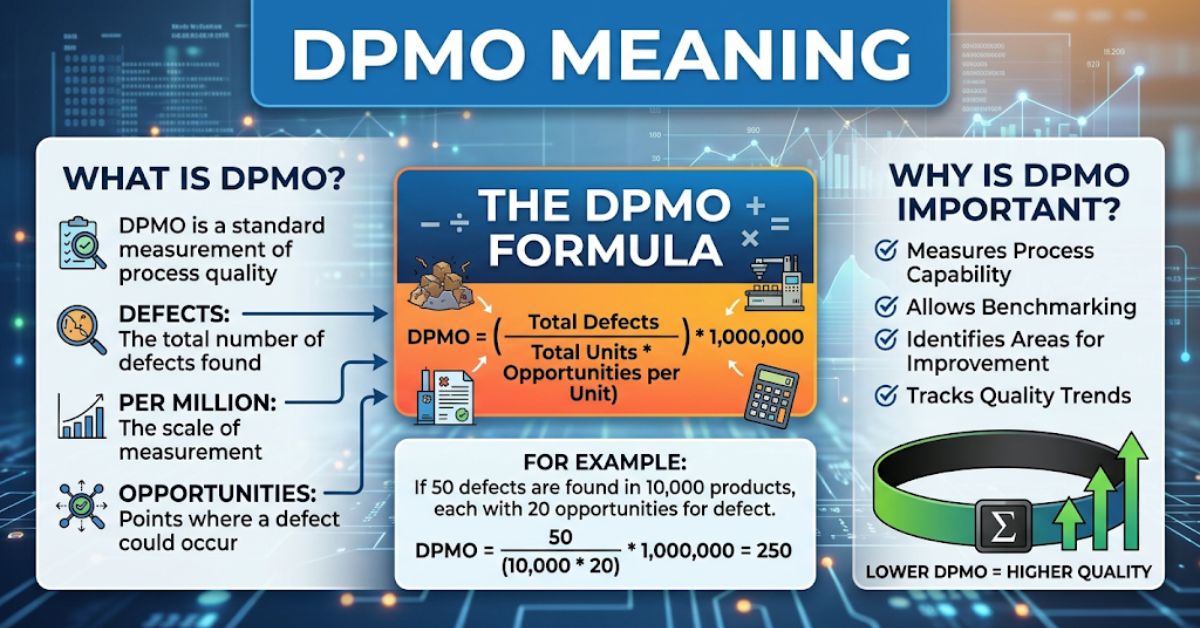
Have you ever wondered how companies measure the smallest mistakes in their work? That’s where DPMO comes in. You’ll often see this term in manufacturing, business reports, and quality management discussions. DPMO stands for Defects Per Million Opportunities. It measures how many defects occur across one million chances for errors. Companies use this metric to spot problems, improve processes, and maintain better quality. A lower score usually means fewer defects and stronger performance.
Understanding the dpmo meaning makes quality reports and workplace conversations much easier to follow. The term plays an important role in Six Sigma and Lean Six Sigma. You may also come across it in healthcare, logistics, customer service, and other industries. Once you understand how DPMO works, those technical numbers become much less confusing. You’ll also see why businesses rely on it to track progress and reduce mistakes.
Origin and Cultural Footprint
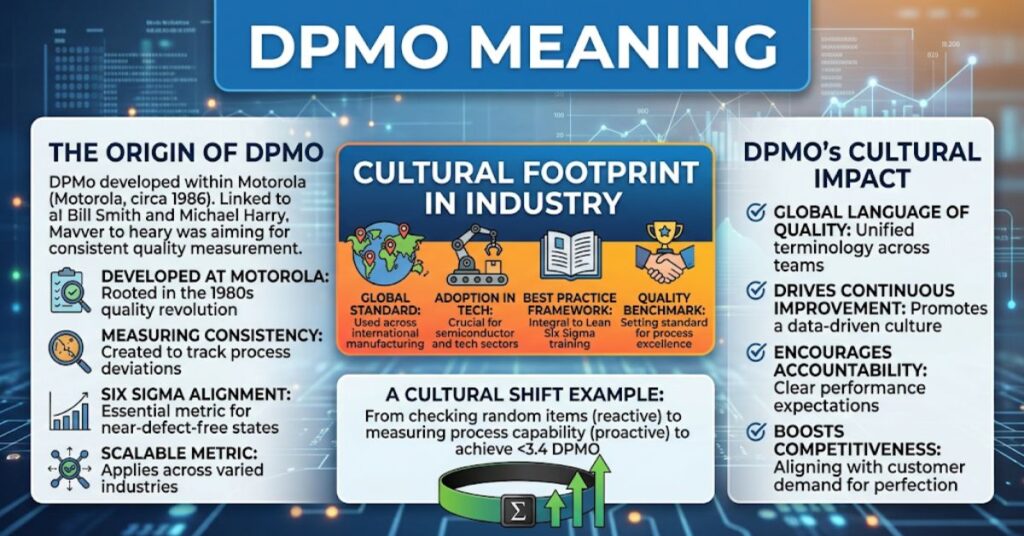
DPMO has deep roots in modern quality management. The term emerged from the Six Sigma movement that Motorola developed during the 1980s. Companies needed a reliable way to measure defects and improve process quality. DPMO provided a consistent quality metric for tracking those problems.
General Electric (GE) helped bring Six Sigma into mainstream business culture during the 1990s. As more companies adopted the approach, DPMO spread across different industries.
Today, the dpmo meaning remains closely connected to business performance and process improvement.
Its influence extends beyond traditional manufacturing into:
- Healthcare billing and finance.
- Logistics and supply chain management.
- Software testing and IT.
- Customer service and call centers.
Business schools and Lean Six Sigma certification programs also teach this important metric.
Other Meanings of DPMO
DPMO has a widely accepted meaning in quality management: Defects Per Million Opportunities. However, some organizations use the same letters for internal purposes. These alternative meanings usually depend on company documents or department-specific terminology.
Two uncommon expansions sometimes appear in corporate shorthand:
- Defined Process Mapping Output: A possible internal label for deliverables created during process mapping exercises.
- Data Process Monitoring Office: A possible departmental name used within certain organizations.
These aren’t widely established definitions. Always check the surrounding conversation before assuming their meaning.
In professional communication, the standard dpmo meaning remains Defects Per Million Opportunities. If someone uses it in an unfamiliar way, asking for clarification can prevent confusion.
Why Does DPMO Have So Many Different Definitions?
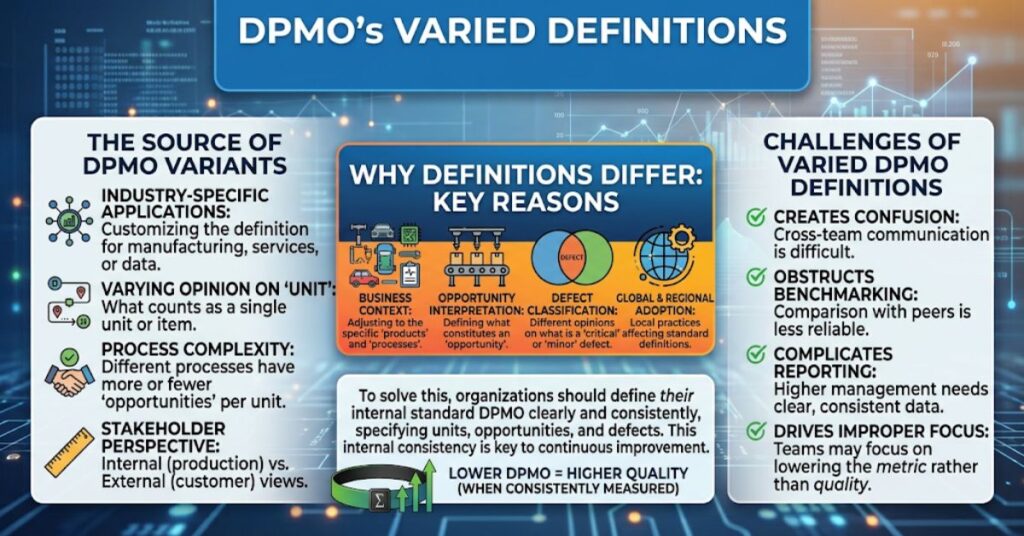
Acronyms often create confusion because different industries use identical letters. DPMO is a good example of this problem. Manufacturing teams usually connect it with defect tracking and Six Sigma. However, another department might use the same abbreviation for an internal project or office.
These overlapping terms are called acronym collisions. They appear frequently in corporate shorthand and workplace jargon.
Context usually reveals the intended definition. Look at the surrounding words and the subject being discussed.
For example:
- A quality manager probably means Defects Per Million Opportunities.
- An internal company wiki might contain a department-specific expansion.
- A production report usually connects DPMO with process quality.
The standard dpmo meaning dominates professional usage.
Does DPMO Mean the Same Thing Outside the US?
Yes, DPMO generally keeps the same meaning across international business environments. Companies in Europe and Asia also use Defects Per Million Opportunities to evaluate process quality.
Six Sigma spread globally through manufacturing companies and process improvement professionals. As a result, this quality metric became familiar across different regions.
Some organizations also use related measurements such as DPM (Defects Per Million). However, DPM and DPMO aren’t identical because they measure defects differently.
Regional variations may affect reporting practices or terminology. They don’t normally change the standard definition.
For example, a manufacturing team in Europe might report DPMO during weekly quality meetings. An Asian production supervisor could use the same metric to review assembly line performance.
Who Uses It Most?
DPMO appears most often among professionals who monitor quality and operational performance. It isn’t a common texting abbreviation. Instead, it belongs mainly to technical reports, workplace discussions, and process improvement meetings.
Different professionals use it to identify problems and measure progress.
Common users include:
- Six Sigma practitioners: Evaluate process quality and improvement results.
- Quality managers: Monitor defect rates and prepare quality reports.
- Manufacturing teams: Track errors across production lines.
- Call center managers: Measure billing errors and customer service problems.
- Engineering leads: Review failed transactions and software testing results.
A production supervisor might check DPMO after sensor recalibration. Similarly, a regional director could review it during a quarterly performance meeting.
Real Conversation Examples Using DPMO
DPMO usually appears in numbers-focused workplace conversations. Employees mention it when discussing quality problems, performance changes, or improvement targets.
Here are two realistic examples.
Example 1: Manufacturing discussion
- Quality Manager: Our DPMO increased to 4,200 this week. What changed?
- Floor Supervisor: We hired a new operator who might need more training on calibration.
Example 2: Customer service review
- Regional Director: Billing error DPMO dropped below 3,000 this quarter. Great improvement!
- Team Lead: Thanks! The new script update helped us catch more errors.
These conversations show how professionals connect DPMO with measurable results.
Unlike casual texting, workplace discussions usually focus on numbers, possible causes, and solutions. Understanding the dpmo meaning helps you follow these exchanges.
Usage of DPMO in Different Contexts
DPMO supports quality measurement across several industries. Although its core purpose stays consistent, each workplace tracks different opportunities for defects.
Here are some common applications:
- Manufacturing: Measures defects such as misaligned parts and failed weld points on an assembly line.
- Customer service: Tracks service mistakes and billing errors across customer interactions.
- Healthcare: Helps evaluate errors in healthcare billing and administrative processes.
- Software testing: Supports defect tracking across transactions and testing opportunities.
- Logistics: Helps monitor processing mistakes and supply chain problems.
For example, an engineering lead might discuss DPMO after a platform migration. A manufacturing team could review the same metric after sensor recalibration.
The goal remains simple: identify defects and improve process quality.
How Professionals Talk About DPMO Today
Modern professionals discuss DPMO through digital dashboards and automated reporting. Instead of manually calculating every figure, teams often use quality software to monitor performance.
During stand-up meetings, managers review changes and discuss possible reasons behind rising defect rates. They also compare current results with earlier scorecards.
Many organizations treat DPMO as a shared team goal rather than simply a management target. Some even use gamification to encourage employees to reduce defects.
Common workplace discussions include:
- Reviewing weekly DPMO results.
- Investigating unexpected quality problems.
- Comparing production line performance.
- Celebrating improvements after process changes.
For example, a quality manager might praise an operator after successful sensor recalibration.
Does DPMO Mean Defects Per Million Orders?
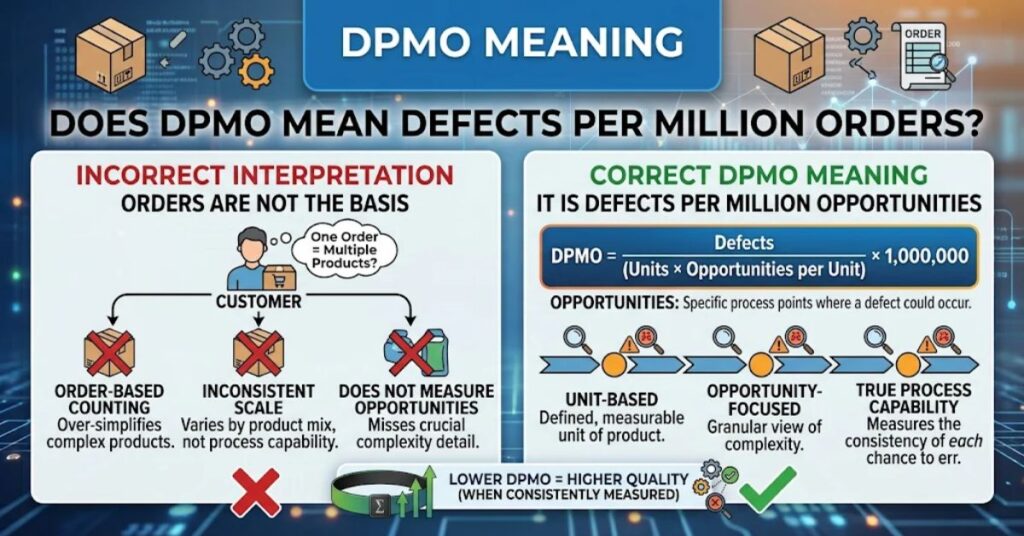
No. DPMO stands for Defects Per Million Opportunities, not Defects Per Million Orders. These expressions sound similar, but they describe different measurements.
The difference comes down to what a company counts. One order can contain several opportunities for defects. For example, an order might include incorrect pricing, missing items, and billing mistakes.
DPMO considers those individual opportunities rather than treating every order as one opportunity.
Remember these distinctions:
- DPMO: Defects per one million opportunities.
- Defects Per Million Orders: An incorrect expansion of the standard acronym.
- DPM: Defects Per Million.
This distinction matters when comparing quality reports. Counting orders instead of actual defect opportunities can produce misleading results.
Meaning Across DPMO Reporting Platforms
DPMO generally keeps its standard definition across reporting platforms. However, different systems may display the metric in different ways.
Understanding these differences helps professionals read reports without confusing internal labels with established terminology.
| Platform | DPMO meaning | Common use |
| Six Sigma software | Defects Per Million Opportunities | Process improvement |
| ERP systems | Defects Per Million Opportunities | Manufacturing and supply chain reports |
| Call center platforms | Defects Per Million Opportunities | Service quality tracking |
| Internal company wikis | Depends on company context | Internal documentation |
For example, a call center manager might review DPMO alongside customer service scorecards. Meanwhile, manufacturing teams may track it through automated reporting.
The dpmo meaning doesn’t normally change between these platforms.
Common Confusions
DPMO often gets confused with other quality metrics because they share similar terminology. However, each measurement serves a different purpose in quality management.
Understanding these differences makes business reports easier to follow.
- DPM: Defects Per Million. It measures defects against a million units or another defined base.
- PPM: Parts Per Million. It measures the number of parts containing a particular issue per million parts.
- FPY: First Pass Yield. It measures how many units pass a process without rework.
- COPQ: Cost Of Poor Quality. It measures expenses caused by quality problems.
- RCA: Root Cause Analysis. It helps identify why defects occur.
- KPI: Key Performance Indicator. It tracks progress toward an important business goal.
DPMO measures process quality rather than directly measuring every aspect of performance.
Related Slang Terms
DPMO isn’t widely recognized as internet slang. It belongs mainly to business vocabulary and technical communication. Still, several related abbreviations appear in manufacturing and workplace discussions.
Here are useful terms to understand alongside DPMO:
- DPM: Defects Per Million.
- PPM: Parts Per Million.
- FPY: First Pass Yield.
- COPQ: Cost Of Poor Quality.
- RCA: Root Cause Analysis.
- KPI: Key Performance Indicator.
These terms frequently appear in quality reports, production meetings, and process improvement discussions.
For example, a quality manager might review DPMO and FPY together. The first tracks defects while the second measures successful first-pass production.
Learning these abbreviations makes technical conversations easier to understand.
How to Reply When Someone Mentions DPMO
When a colleague mentions DPMO, respond according to the situation. If the number increases, ask what caused the change. If it decreases, acknowledge the improvement and ask which process worked better.
A thoughtful reply keeps the conversation focused on practical solutions.
When DPMO increases:
- Is there a particular process causing the increase?
- Did anything change on the production line?
- Have we identified the root cause?
When DPMO decreases:
- Great improvement! What changes helped?
- That’s excellent progress. Can we apply this elsewhere?
- The new process seems to be working well.
For example:
Colleague: Our DPMO dropped significantly this month.
You: That’s great news! Did the calibration changes make the difference?
This approach turns a numbers-focused conversation into a useful learning moment.
When Did DPMO Go Mainstream?
DPMO gained wider recognition during the 1990s as Six Sigma became popular among major businesses. Motorola introduced the quality improvement approach during the 1980s. General Electric later helped bring it into mainstream corporate management.
As more organizations adopted these methods, DPMO became a familiar quality metric across several industries.
By the early 2000s, businesses beyond manufacturing had started using similar quality management practices. Healthcare, finance, logistics, and customer service teams also applied process improvement methods.
Lean Six Sigma certification programs helped spread this knowledge further.
Today, Six Sigma practitioners and process improvement professionals use DPMO to evaluate defects and monitor performance. Its role has expanded, but its core meaning remains unchanged.
Conclusion
Understanding the dpmo meaning helps you see how businesses measure quality and reduce mistakes. DPMO stands for Defects Per Million Opportunities. It shows how often defects happen across one million chances for errors. A lower score points to a more reliable process. Teams use this measure to find weak spots and track progress. It helps managers set goals and compare results over time.
Now that you know the dpmo meaning, you can read quality reports with confidence. You may see DPMO in manufacturing, healthcare, customer service, logistics, and Six Sigma projects. Remember that the dpmo meaning is about opportunities for defects, not the number of products made. When someone mentions DPMO at work, think about process quality and improvement. Knowing the dpmo meaning makes technical discussions easier to follow and helps you understand why small changes lead to better results.
FAQs
What does DPMO mean in slang?
DPMO does not have a widely recognized slang meaning. It usually stands for Defects Per Million Opportunities in quality management and business discussions.
What is DPMO in slang?
DPMO is not a common texting or slang abbreviation. Its meaning depends on context, but it most often refers to a Six Sigma quality metric.
Is DPMO used on social media?
DPMO is not widely used as social media slang. You may see it in posts about business, manufacturing, workplace quality, or process improvement.
What does DPMO stand for?
DPMO stands for Defects Per Million Opportunities. It measures the number of defects found across one million possible opportunities for errors.
What does DPMO stand for in texting?
In texting, DPMO usually has no standard meaning. If someone uses it in a work-related message, they likely mean Defects Per Million Opportunities.
