

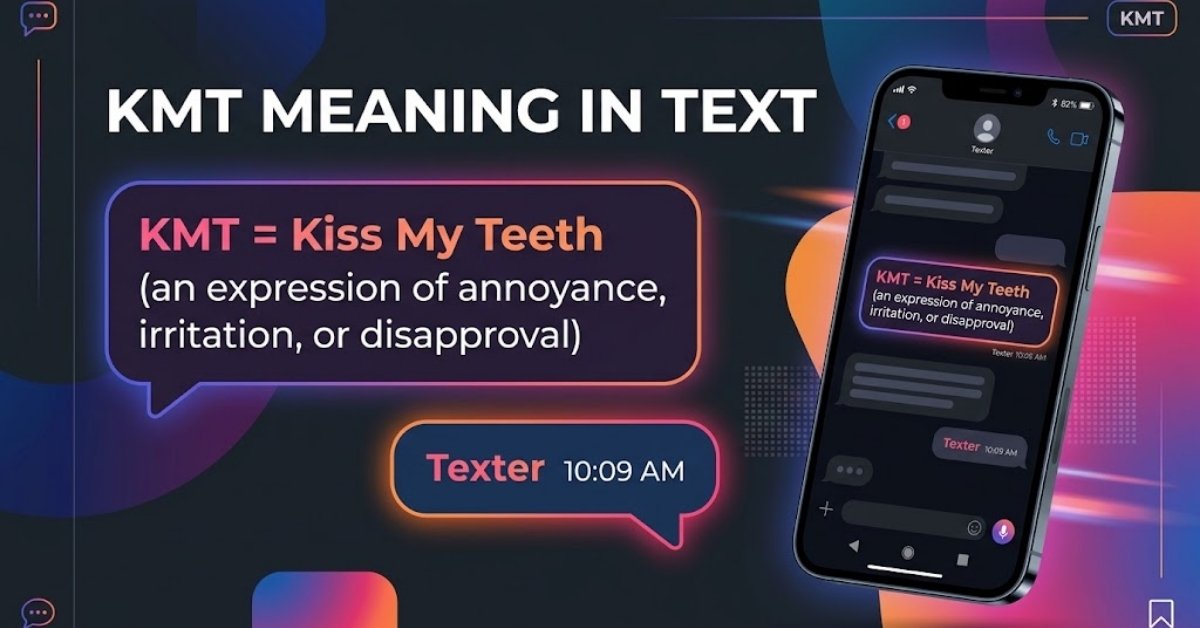
You got a message that just says “kmt” and now you’re staring at your screen. Was that rude? Was it a joke? Did you do something wrong?Relax. KMT stands for Kiss My Teeth. It’s a texting slang reaction that shows annoyance, disbelief, or disappointment, and it usually isn’t aimed at you.
Think of it as the typed version of a sound. You’ll see why in a minute, plus where it came from, how to answer it, and what else the letters can mean.
Meaning & Definition
KMT is a text abbreviation for “kiss my teeth.” It’s a quick emotional reaction that people drop into text messages when something irritates, shocks, or lets them down.
You’ll spot it in chat conversations, direct messages (DMs), and comment sections all over the web. It’s internet slang that does a lot of work in three letters.
Here’s the key point. The phrase doesn’t literally mean someone wants to kiss their teeth. It stands in for a real physical expression, and that’s where the meaning lives.
What Does KMT Meaning in Text?
When you see KMT meaning in text, read it as a sigh with attitude. The sender is saying, “Ugh, really?” or “Come on, seriously?”
Picture a friend who texts, “Told him we’d leave at 8. He’s still not up. kmt.” That’s frustration and annoyance wrapped into one tiny reaction word.
The emotional tone depends on context. Sometimes it’s disbelief. Other times it’s disapproval or a bit of sarcasm. Read the whole message before you decide how heavy it is.
Background / Origin
KMT comes from a real sound. People suck their teeth, or kiss their teeth, by pulling air through the gap between the teeth and tongue. It makes a long “tsss” or “steups” noise that signals irritation without a single word.
The gesture is strongly tied to Caribbean slang and Caribbean culture. You’ll hear it in Jamaica, Trinidad, Guyana, and across Caribbean communities abroad. It’s also common in African English-speaking cultures and in UK slang, especially among British culture shaped by Caribbean and African families.
As language evolution goes, this one is simple. The sound moved from face to face talk into messaging apps, then people shortened it to KMT so they could type it fast. That’s a clean example of slang history in action.
Usage in Different Contexts
Context decides everything with conversational slang. The same three letters can sound playful with your best friend and sharp with a stranger.
Pay attention to who’s talking, what just happened, and what punctuation or emoji comes with it. Those small clues tell you the tone.
General Usage
In everyday conversations, people use KMT to react to frustrating situations. A late bus, a spoiled plan, a ghosted message, or a bad take online can all trigger it.
It’s a quick reaction, so people rarely explain it. They type it, send it, and move on. You’ll see it most in friend group chats, gaming chats, and casual online discussions.
Some people stack it for effect. “Kmt kmt kmt” tells you the sender has hit their limit. It’s the digital version of an eye roll that won’t stop.
Formal vs Informal Usage
KMT lives in informal language. It fits casual conversations, informal texting, and private chats where people know your style.
In formal communication, skip it. Don’t use it in professional communication, workplace communication, or academic writing. A boss or professor may not know it, and they could read it as rude.
If you need to show frustration at work, write it out. “I’m disappointed with the delay” does the job without confusion. That’s solid texting etiquette.
KMT Meaning on Social Media Platforms
Each app has its own flavor, but KMT shows up almost everywhere. People use it as a reaction comment under posts that make them groan. It also pops up in stories, streak replies, and group chats.
On WhatsApp and Snapchat, it’s mostly one on one or in small circles. On Instagram, you’ll find it in captions and DMs. On Twitter (X), people drop it into replies when a take or headline feels ridiculous.
TikTok is where it spreads fastest. In viral videos, creators use it in captions, and commenters answer with it when a clip shows something annoying or unbelievable. That’s how a regional term turns into viral slang and part of global slang.
The meme culture angle matters too. Some reaction posts pair KMT with a screenshot or a face that says everything. It adds a punchline without extra words.
Other Meanings in Different Fields
Not every KMT is about teeth. Always check the setting before you assume. You can lose a lot of time on misunderstanding if you don’t.
Here are a few other uses you might run into:
- Kuomintang: The Chinese Nationalist Party, often shortened to KMT in news about Taiwan and Chinese history.
- Kemet: Ancient Egyptians called their land Kemet, and the name is often written as “kmt” in historical and cultural writing.
- Biology shorthand: In genetics, KMT is used as a prefix for histone lysine methyltransferases, such as KMT2A.
- Project or system names: Teams sometimes use KMT as project shorthand or an internal tool name.
These examples show how abbreviations double up across fields. A medical abbreviation and a texting shortcut can share the same letters and have nothing in common.
The rule is easy. If the chat is casual and the mood is annoyed, it’s Kiss My Teeth. If the topic is politics, history, or science, it’s probably one of the others.
Examples of KMT Meaning in Text in Sentences
Seeing it in action helps more than any definition. Here are some sentence examples you can picture in real chat examples:
- “He said he’d call back an hour ago. Still nothing. kmt.”
- “They raised the price again? Kmt, I can’t.”
- “She left me on read for two days and then asked for a favor. Kmt.”
- “My phone died right before the game ended. Kmt.”
- “You really thought I wouldn’t notice? Kmt.”
Notice how it often lands at the end or start of a line. It acts like a sigh that closes a thought. That’s classic expressive texting.
Here’s a lighter one. “You ate the last slice again? Kmt, I’m done with you.” The tone is playful, and nobody’s really angry. This is where teasing and humorous response come in.
Common Misconceptions
Lots of people get this one wrong. The first mistake is thinking KMT is always rude expression aimed at the reader. Most of the time, it’s about the situation, not you.
The second mistake is treating it as literal. No one is asking for a kiss, and no one is being romantic. It’s a reaction sound turned into text.
The third is assuming it only means anger. It can also show shock, surprise, or plain disappointment. That’s why misinterpretation happens so often in cross-cultural chats.
One more thing to know. In some settings, the actual teeth-sucking gesture can feel disrespectful, especially when done at someone. The typed version is softer, but the sender’s intent still matters.
Similar Terms & Alternatives
KMT has a lot of cousins in digital slang. Some carry the same mood, and others only overlap a little. Here’s a quick slang dictionary style list:
- SMH: Shaking My Head. A disapproval or disbelief reaction.
- Tsk: A text version of the same teeth sound, often used in comics and chats.
- OMG: Oh My God. Shows shock or surprise.
- BRUH: A flat, tired reaction to something silly.
- LOL: Laughing Out Loud. Humor, not annoyance.
- IKR: I Know Right. Agreement with a shared feeling.
- OMG FR: Oh My God, For Real. Strong surprise at something true.
These internet abbreviations and similar slang terms give you slang alternatives when KMT feels too sharp. Pick one that fits your communication style and your audience.
How to Respond to KMT Meaning in Text When Someone Uses It
First, figure out the mood. Is your friend annoyed at a situation, at you, or at the world? A quick scan of the last few messages will tell you.
If it’s about a situation, offer support. Try, “Ugh, that’s rough. What happened?” or “That sounds exhausting.” A supportive response keeps the chat warm.
If it seems aimed at you, ask instead of guessing. “Did I say something off?” clears the air fast. If it’s a joke, match the vibe with a funny reply like “I know, I know, I’m the worst.”
Here are a few reply tips to keep handy:
- Match the tone. Playful gets playful. Serious gets calm.
- Ask a short question. It shows you care and avoids fights.
- Skip the lecture. Nobody wants a speech after a sigh.
- Use an emoji if it fits. A shrug or eye roll can ease the mood.
Difference Between KMT Meaning in Text and Similar Terms
People mix up KMT and SMH all the time. They sound alike, but they’re not twins. KMT carries more irritation and attitude, while SMH leans toward quiet disapproval.
Compare KMT and “tsk.” Tsk feels lighter, almost like a tut. KMT has more bite and a stronger cultural root.
And what about BRUH or LOL? BRUH says, “I can’t believe you did that” in a flat way. LOL says something’s funny. KMT says something’s annoying. This comparison of slang helps you pick the right word at the right time.
Relevance in Online Conversations & Dating Apps
KMT matters in online conversations because fast communication strips out tone. You can’t hear a sigh through a screen, so letters have to do it.
On dating apps, it shows up in dating conversations when someone feels ignored or let down. For example, “You matched with me then vanished for a week, kmt.” That’s disappointment in chats with a little humor on top.
A small warning applies here. On a first chat, KMT can read as dismissive tone to someone who doesn’t know the term. If you’re getting to know someone, a plain sentence usually works better.
For online friendships, though, it’s great. It tells your friends you’re annoyed without writing a paragraph. That makes it a handy part of texting culture and online community life.
Why KMT Keeps Spreading Online
Three things push it along. First, it’s short, and texting shortcuts win when people type on phones. Second, it carries emotion that plain words can’t.
Third, internet culture loves borrowing from regional speech. As more people join global platforms, they pick up terms from each other. That’s how youth slang moves between teenagers and young adults worldwide.
It also shows cultural influence in a positive way. A phrase rooted in Caribbean English and UK English now fits into digital culture for everyone. Respecting that source is part of good online behavior.
Conclusion
KMT meaning in text boils down to Kiss My Teeth, a quick reaction to something irritating, shocking, or disappointing. It comes from a real sound with deep roots in Caribbean and African communities, and it travels well in modern slang.Now you know how to read it, reply to it, and avoid mix-ups with other meanings. Context and tone are your best guides.
Have you seen KMT used in a way that surprised you? Drop your story in the comments, and share this guide with a friend who keeps asking what it means. We’ll keep this page fresh as new slang pops up.
FAQs
What does KMT mean in texting?
KMT means Kiss My Teeth. It’s a texting reaction that shows annoyance, disbelief, or disappointment. Think of it as typing a sigh with attitude.
Is KMT rude?
It can be, but usually it isn’t. Most people aim it at a situation, not at you. If it feels pointed, ask what’s up before you react.
Where is KMT commonly used?
You’ll see it in friend group chats, DMs, comment sections, and gaming chats. It’s strong on WhatsApp, Snapchat, Instagram, Twitter (X), and TikTok. It’s also common in Caribbean, African, and UK communities.
What does KMT mean on TikTok?
On TikTok, it’s a reaction to something annoying or unbelievable. Creators use it in captions, and viewers use it in comments. It adds humor and attitude in a few letters.
Can KMT have different meanings?
Yes. It can also mean Kuomintang, refer to Kemet in historical writing, or appear as a prefix in biology, like KMT2A. Context tells you which one fits.
Should I use KMT in formal conversations?
No. Keep it for casual chats with people who know the term. For work or school, write out your feeling in plain, clear words.
