

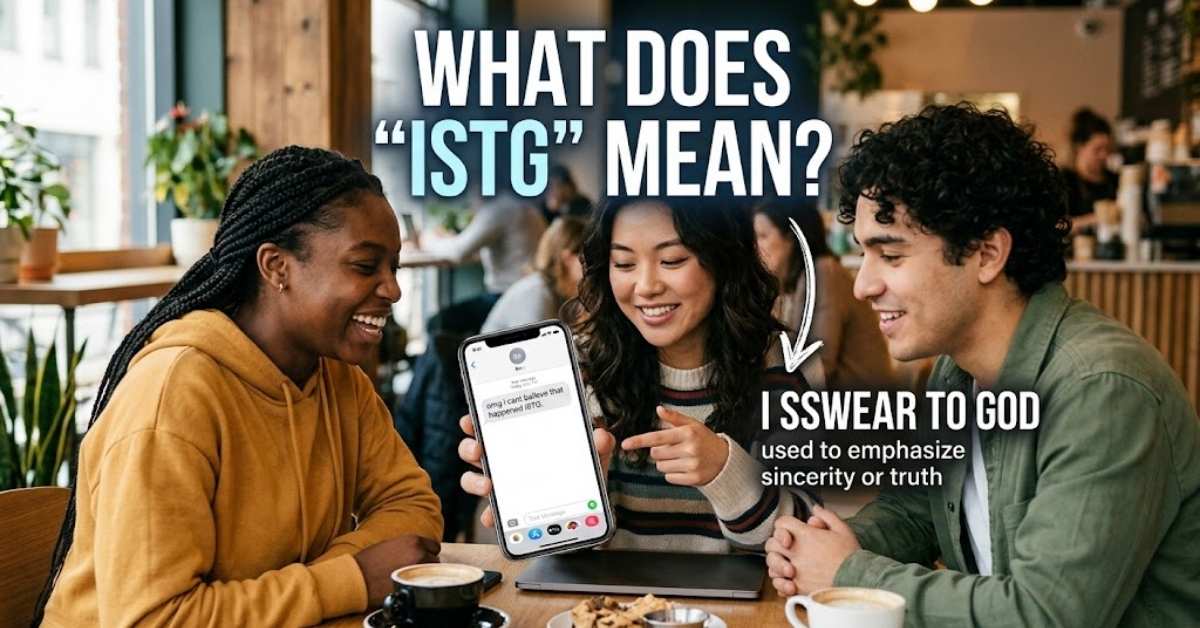
ISTG means “I swear to God.” People type it to show they’re completely serious about what they just said. It’s one of the most common texting abbreviations in everyday texting.Ever got a message like “istg I’m done with this” and wondered how serious it was? Or maybe you wanted to type it yourself but weren’t sure it fit the chat.
You’re not alone.This guide explains the ISTG meaning in text, shows how people use it, and gives you 24 alternatives to I swear to God. Pick the one that matches your mood and your audience.
What Does ISTG Mean in Text?
ISTG stands for “I swear to God.” It’s an acronym that adds emphasis to a statement. Think of it as a raised hand in court, shrunk down to four letters.
You’ll spot ISTG meaning in chat on WhatsApp, Instagram, Snapchat, and group chats. People use it to show sincerity, urgency, or strong feelings. Sometimes it’s about expressing frustration. Other times it’s expressing disbelief or simply expressing the truth.
Here’s a quick feel for it. “ISTG I left my keys on the table” means “I’m telling you the truth.” But “ISTG if he cancels again, I’m done” shows pure annoyance.
ISTG Full Form and Where It Came From
The ISTG full form is “I swear to God.” People have used that phrase for centuries to back up a claim. Swearing an oath is as old as language itself.
Online, internet slang shrinks everything. Early SMS character limits and fast typing in chat rooms pushed people toward short forms like LOL, BRB, and ISTG. Younger generations then carried the habit onto social media slang feeds.
Today the ISTG abbreviation works more like a tone marker than a religious vow. Most people typing it aren’t thinking about faith at all. They just want you to know they mean it.
How People Use ISTG in Real Chats
Seeing it in action beats any definition. Here are a few ISTG examples you’d actually run into:
- Urgency: “ISTG answer your phone, it’s an emergency.”
- Honesty: “ISTG I didn’t read your diary.”
- Frustration: “ISTG this app crashes every five minutes.”
- Disbelief: “ISTG that was the weirdest movie ever.”
Notice how the same three letters shift with context. The words around ISTG set the tone of communication. That’s why reading the whole message matters.
Best Alternatives to ISTG (With Examples)
Maybe ISTG feels too strong for your chat. Or maybe you’ve used it ten times today and want some variety. Good news: English has plenty of ways to say the same thing.
Below are 24 ISTG alternatives, grouped by mood. Each one comes with a quick example so you can borrow it right away.
Casual Alternatives (For Everyday Texting)
These fit casual chats with friends and friendly conversations. They’re short, relaxed, and easy to type.
- For real (FR): “FR, that was the best pizza I’ve had.”
- No cap: “No cap, I finished the whole season overnight.”
- On God: “On God, I’m not lying.”
- Dead serious: “I’m dead serious, call me back.”
- Legit: “That concert was legit amazing.”
- Straight up: “Straight up, I forgot it was your birthday.”
- On everything: “On everything, I’ll be there at eight.”
- No lie, no joke: “No lie, no joke, I saw him at the airport.”
Quick note: “no cap” and “on God” are popular texting slang with roots in Black American English. They’ve gone mainstream, but they still read as very casual.
Professional and Polite Alternatives (For Work or Formal Messages)
At work, you want message clarity and a respectful tone. These phrases show confidence without sounding dramatic.
- I assure you: “I assure you the report will be ready by Friday.”
- I can guarantee: “I can guarantee we’ll meet the deadline.”
- You have my word: “You have my word that I’ll follow up today.”
- I give you my full assurance: “I give you my full assurance that the data is accurate.”
- I can personally vouch: “I can personally vouch for her work.”
- I stake my reputation on it: “I stake my reputation on this plan.”
These work well in professional emails and other work-related interactions. They keep professionalism intact while still expressing sincerity naturally.
Emphatic Alternatives (For Expressing Strong Feelings)
Sometimes you need more punch. These phrases carry weight when something really matters to you.
- I swear on everything: “I swear on everything, I didn’t tell anyone.”
- I put that on my life: “I put that on my life, it’s the truth.”
- Mark my words: “Mark my words, this team will win.”
- I promise: “I promise I’ll fix it tonight.”
- Trust me: “Trust me, you’ll love this place.”
Use them sparingly. If every message sounds like a life or death pledge, people stop taking the big ones seriously.
Lighthearted and Playful Alternatives
Want to joke around? These add humor in conversations and keep the mood light. They’re perfect for joking around with close friends.
- Cross my heart: “Cross my heart, I’ll share the fries.”
- Scout’s honor: “Scout’s honor, I won’t spoil the ending.”
- Pinkie promise: “Pinkie promise I’ll water your plants.”
- I’d bet my last dollar: “I’d bet my last dollar he’s late again.”
- Hand to heart: “Hand to heart, that was my best cooking ever.”
These feel warm and a bit silly. They also avoid any religious concerns, which makes them a safe pick for mixed groups.
ISTG Alternatives for Texting
Texting moves fast, so the best swaps are short and easy to type. Here’s a quick cheat sheet for natural texting phrases by situation.
| Situation | Try This |
| Quick reply to a friend | FR, No cap, Legit |
| Showing you’re serious | Dead serious, On everything |
| Promising something | I promise, You have my word |
| Teasing someone | Pinkie promise, Cross my heart |
| Work chat | I assure you, I can guarantee |
Mix them up. Repeating the same phrase gets stale, and conversational language works best when it feels fresh. Variety also shows you’re a thoughtful digital communicator.
Is ISTG Offensive?
Short answer: sometimes. The phrase includes a reference to God, so it carries religious undertones. For many people that’s no big deal. For others, it feels like casual offensive language.
Some folks see swearing on God as disrespectful when used for trivial things. Others skip it for personal faith reasons. Neither view is wrong.
If you’re unsure, pick a neutral option like “I promise” or “for real.” It keeps you out of trouble in sensitive conversations and avoids misunderstandings.
When to Choose the Right Alternative to ISTG?
Picking the right phrase is easier when you ask three quick questions. Who’s reading this? What’s the setting? And how strong do I want to sound?
That’s audience awareness at work. A phrase that lands perfectly in a group chat can flop in an email to your manager. Choosing the right alternative is really about appropriate language for the moment.
A good rule: match the other person’s energy. If they type in slang, you can too. If they write full sentences, follow their lead.
When NOT to Use ISTG
Some situations call for a pause before you hit send. Here’s when to skip ISTG:
- Professional settings: Emails to clients, bosses, or HR need a formal tone.
- Sensitive conversations: Grief, faith, or serious conflict deserve careful wording.
- Mixed audiences: Older relatives or religious colleagues might find it off putting.
- Official messages: Job applications, complaints, and legal notes should stay slang free.
In these cases, ISTG in professional messages can hurt your credibility. Go with “I assure you” or “you have my word” instead.
When It’s OK to Use ISTG
Now the fun part. ISTG is perfectly fine in many spots:
- Casual chats with friends: Everyone knows the vibe.
- Group chats: Fast, expressive, and low stakes.
- Social posts and comments: Great for emphasis or humor.
- Venting moments: “ISTG my landlord is impossible.”
In short, ISTG in friendly chats is totally normal. Just keep your audience in mind, and you’re set.
Texting Etiquette: Formal vs Informal Language
Texting etiquette isn’t about strict rules. It’s about reading the room. Formal versus informal language shifts with the platform, the person, and the topic.
A text to your best friend can be messy and slangy. A message to a new coworker should be clearer and warmer. Both are fine when they match the communication context.
Also remember that tone doesn’t travel well in text. A sarcastic “ISTG” can read as angry. When in doubt, add a quick emoji or a clarifying line.
Related Texting Slang You’ll See Alongside ISTG
ISTG rarely shows up alone. You’ll often see it near other chat abbreviations and online language trends. Knowing them helps you follow the conversation.
For example, WYA meaning is “where you at?” and it’s a common check in message. Meanwhile, the C’est la vie meaning is “that’s life,” a French phrase people drop after a small setback. Both pop up in daily messaging and social media messaging all the time.
Pairing them is easy. “WYA? ISTG I’ve been waiting for twenty minutes.” Short, clear, and very human.
Quick Tips for Using ISTG and Its Alternatives Well
A few habits keep your messages sharp. They also protect your message clarity when typing fast.
- Don’t overuse it. If every line has ISTG, it loses emphasis.
- Match your tone. Serious topics need serious wording.
- Know your reader. Check who’s in the chat before you type.
- Keep it honest. Use these phrases for real truths, not tall tales.
Do this, and your effective communication improves fast. People will trust your strong emphasis in writing more because you save it for what matters.
Conclusion
ISTG is a simple way to say “I swear to God” and show you mean it. It fits casual texting well, but it needs care in professional or sensitive chats. With 24 alternatives in your pocket, you can match any tone.
So which one will you try first? Drop your favorite swap in the comments, and share this guide with a friend who overuses ISTG. Got a phrase we missed? Tell us, and we’ll add it in the next update.
FAQs
What does ISTG mean in texting?
It means “I swear to God.” You use it to stress that you’re telling the truth or feeling something strongly.
Is ISTG rude?
Not always. It can feel rude to people who find religious phrases casual or disrespectful. When unsure, choose a neutral swap.
Can I use ISTG at work?
It’s best to skip it. Use polite alternatives like “I assure you” or “I can guarantee” in professional communication.
What’s the most popular ISTG alternative?
“For real” and “no cap” are the most common among friends. For work, “you have my word” is a solid pick.
